For decades, Americans were told to build every meal around grains. We did. And what happened?
Nearly 1 in 3 adolescents now has prediabetes. Over 70% of adults are overweight or obese.
Chronic disease eats up almost 90% of US healthcare spending. The Standard American Diet — SAD, and the name fits — didn’t keep us healthy.
It made a generation sick.
So when I see the government finally say “actually, maybe we had this backwards,” I feel two things.
First: vindication, honestly.
Second: sympathy for everyone who followed the old rules in good faith — including the doctors, dietitians, and diabetes educators who built entire careers telling patients to load up on “healthy whole grains” at every meal.
Pivoting after thirty years of teaching something is hard. Admitting you were part of the problem is harder.
But if you’re reading this, you’re probably past waiting for institutions to catch up. You want answers now. So let’s talk.
If You Have Diabetes, You Already Know the Hard Parts
I’m not going to waste your time explaining what diabetes is. You already know. You’ve felt the fatigue after meals. You know what an A1c number means and what yours is. You know the cost of metformin, or insulin, or the newer GLP-1 drugs everyone’s suddenly talking about — and the fights with insurance to get them covered.
You know the fear of complications — the neuropathy, the vision changes, the slow-healing wounds, the kidney worries that hover in the background of every doctor’s visit.
What you might not know — because nobody told you clearly — is that what you put on your plate is one of the most powerful tools you have. Not as a replacement for your doctor. Not as a miracle. But as something real, measurable, and in your control.
And the research now backs this up in a way it didn’t twenty years ago.
A 2021 meta-analysis published in the BMJ looked at adults with type 2 diabetes who followed a low-carb diet for six months. The remission rate — meaning their A1c dropped below 6.5%, the diagnostic threshold — was 57% in the low-carb group versus 31% in the control group. A 2024 study from the University of Alabama at Birmingham found that people on a carb-restricted diet actually recovered beta-cell function in their pancreas — the cells that make insulin. That’s something no medication on the market can currently do. And an eight-year primary care study by Dr. David Unwin in the UK watched patients drop their A1c from 63 to 46 just by cutting carbs, with many discontinuing medication entirely.
So the question isn’t really whether food can help. It’s which food.
The Real Problem Isn’t Sugar. It’s Everything That Becomes Sugar.
Here’s the thing most people miss. When your doctor said “watch your sugar,” you probably cut out soda and desserts and felt like you were doing the work. Good start. But then you sat down to a bowl of cereal, or a sandwich at lunch, or pasta at dinner, and your blood sugar still spiked — because your body breaks all of those down into glucose almost as fast as sugar itself.
A slice of white bread can raise your blood sugar faster than a spoonful of table sugar. A bowl of cornflakes scores higher on the glycemic index than ice cream. This isn’t a trick. This is just chemistry. Refined carbs are sugar, just in a slower-acting disguise.
The diabetes diet that actually works — the one the research keeps pointing to — isn’t about low-fat, low-salt, low-joy. It’s about low glycemic impact. Eat foods that don’t flood your bloodstream with glucose. Give your pancreas a break. Let your body learn how to use insulin properly again.
What to Eat: The Real Food List
I’m going to keep this simple. These are the foods that, in general, don’t spike blood sugar much and that most diabetes-reversal research revolves around.
Proteins (eat freely, at every meal)
- Eggs, whole — don’t fear the yolk, that’s where most of the nutrition is
- Chicken, especially with skin on
- Pork, including fattier cuts
- Beef — grass-fed when you can swing it, but regular is still good
- Fish — salmon, sardines, tuna, mackerel, cod
- Shellfish — shrimp, scallops, mussels
- Organ meats like liver, if you can handle them
Protein at every meal stabilizes blood sugar, keeps you full for hours, and protects muscle mass (which matters more than ever if you’re on a GLP-1 drug).
Non-starchy vegetables (eat a lot)
- Leafy greens — spinach, kale, arugula, romaine, Swiss chard
- Cruciferous — broccoli, cauliflower, cabbage, Brussels sprouts
- Zucchini, asparagus, green beans
- Bell peppers, tomatoes, cucumbers
- Mushrooms
- Celery, radishes, jicama
Good fats (don’t be scared of these)
- Olive oil, extra virgin
- Butter, real butter — not margarine
- Avocado and avocado oil
- Coconut oil
- Nuts — almonds, walnuts, pecans, macadamias
- Seeds — chia, flax, pumpkin, sunflower
- Cheese, full-fat
Low-sugar fruits (small portions)
- Berries — strawberries, blueberries, raspberries, blackberries
- Green apple
- Avocado (technically a fruit)
- A small amount of melon or citrus
Fermented and cultured foods
- Plain full-fat Greek yogurt
- Kefir
- Sauerkraut, kimchi, pickles (the refrigerated kind, not shelf-stable)
What to Minimize or Avoid
- White bread, bagels, tortillas, pasta
- White rice and most rice-based dishes
- Sugary drinks — soda, juice, sweet tea, flavored lattes
- Pastries, cookies, cakes, muffins
- Most breakfast cereals, even the “heart healthy” ones
- Ultra-processed “diet” or “low-fat” products (they usually replace fat with sugar)
- Vegetable and seed oils — corn, soybean, canola, sunflower (use olive, avocado, or butter instead)
- Fruit juice, even “100% fresh” (it’s concentrated sugar without the fiber)
- Most commercial breads, even whole wheat — they still spike glucose
- Granola and granola bars (marketing fiction)
Sample Meal Ideas (The Kind You’ll Actually Eat)
I’m not going to hand you a week of quinoa bowls you’ll never make. Here’s how real meals look when you’re eating this way.
Breakfast
- Three eggs scrambled in butter with sautéed spinach and a side of bacon
- A two-egg omelet with cheese, mushrooms, and diced ham
- Plain full-fat Greek yogurt with a small handful of berries and chopped walnuts
- Leftover steak sliced over arugula with olive oil and a fried egg
Lunch
- Grilled chicken Caesar salad (skip the croutons, add extra parmesan)
- Burger without the bun, wrapped in lettuce, with a side salad
- Tuna salad scooped into avocado halves
- Bunless hot dog with sauerkraut and a pickle
Dinner
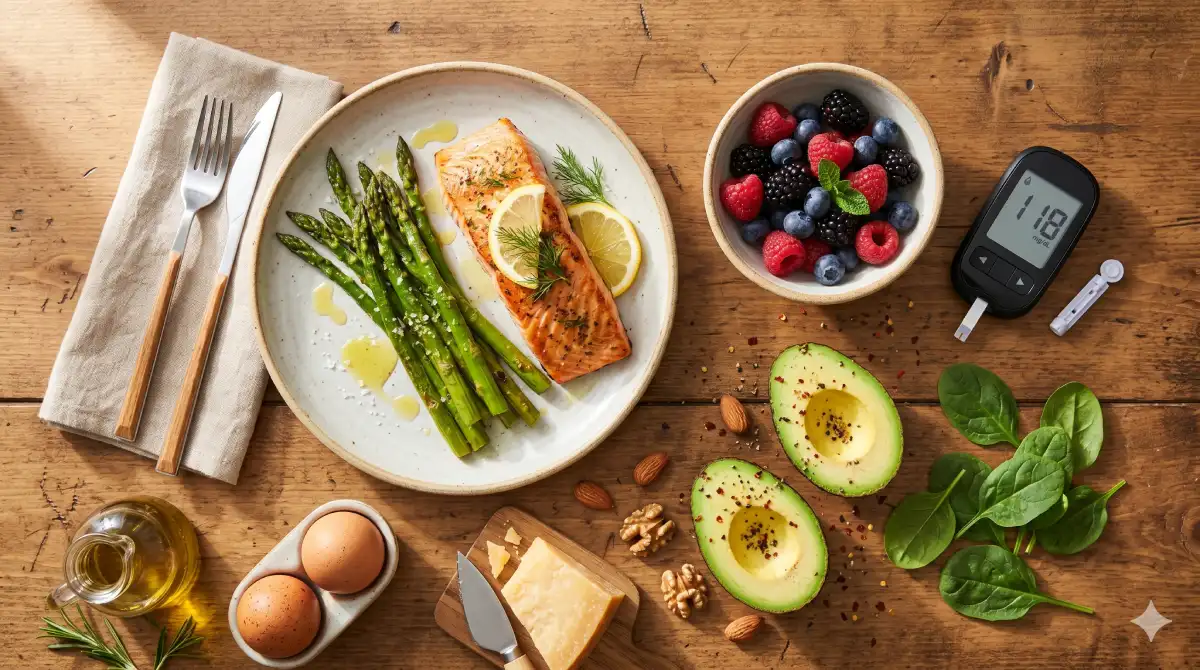
- Baked salmon with lemon butter and roasted broccoli
- Ribeye steak with sautéed mushrooms and asparagus
- Roast chicken thighs with cauliflower mash
- Ground beef taco bowls — lettuce base, cheese, salsa, sour cream, guacamole, no shell or rice
Snacks
- Hard-boiled eggs
- Cheese cubes and olives
- A small handful of nuts
- Pork rinds (yes, really — zero carbs)
- Celery with almond butter
- Avocado mashed with salt and lime
Notice what’s not on any of these lists? Bread. Rice. Pasta. Sugary drinks. That’s not a punishment — it’s the point. You’re letting your body rest from a constant glucose flood it was never designed to handle.
A Few Honest Notes Before You Start
Talk to your doctor, especially if you’re on medication.
This way of eating works so well that if you’re on insulin or sulfonylureas, your numbers can drop fast. That’s a good problem, but it needs medical adjustment, not a DIY approach.
The first two weeks are the hardest.
Your body is addicted to a glucose drip. Expect cravings, maybe a headache, maybe crankiness (they call it the “keto flu” or “carb flu”). Push through with extra salt, extra water, and extra protein.
Don’t count calories.
Count carbs if you want — aim for under 100g a day to start, under 50g if you want faster results. But mostly, just eat real food until you’re satisfied.
Fat is not the enemy here.
Decades of fear-mongering told us otherwise, and decades of rising diabetes rates are the result. Eat the yolk. Use the butter. Skip the “low-fat” version of anything.
The Hidden Cause Most People Never Hear About
Here at Health Tidbits, I don’t just write about food and movement — though both are foundational, and I’ll keep writing about them. I also believe something most diabetes resources quietly skip over.
Your mind matters. A lot.
There’s a link between chronic stress, suppressed emotions, long-held beliefs about scarcity and worth, and the way your body regulates blood sugar. It’s not woo. Cortisol, the stress hormone, directly raises blood glucose. Chronic emotional stress creates chronic insulin resistance. And the stories we tell ourselves — about deserving to rest, about our worth, about whether abundance is for us — shape the daily decisions that either heal us or keep us sick.
I’ve been sitting with this idea for a long time. It’s shaped the way I approach my own health after I burned out from overwork. And I want to share what I’ve learned.
If you’re curious about the connection between diabetes and your thinking — the one hidden cause almost no doctor will bring up in a ten-minute consult — download my free ebook. I break down the mind-body link in plain language, with the research and the reflection questions to help you start untangling it.
Because the pyramid was wrong. The low-fat advice was wrong. And the idea that diabetes is only about your pancreas? That might be the most incomplete story of all.
Eat real food. Move gently and often. And don’t forget to look at what’s happening between your ears — it might be the piece that finally makes the rest click.
References
Goldenberg, J. Z., Day, A., Brinkworth, G. D., Sato, J., Yamada, S., Jönsson, T., Beardsley, J., Johnson, J. A., Thabane, L., & Johnston, B. C. (2021). Efficacy and safety of low and very low carbohydrate diets for type 2 diabetes remission: Systematic review and meta-analysis of published and unpublished randomized trial data. BMJ, 372, m4743.
Gower, B. A., Goss, A. M., Yurchishin, M., Deemer, S. E., Sunil, B., & Garvey, W. T. (2024). Effects of a carbohydrate-restricted diet on beta-cell response in adults with type 2 diabetes. The Journal of Clinical Endocrinology & Metabolism.
Unwin, D., Khalid, A. A., Unwin, J., Crocombe, D., Delon, C., Martyn, K., Golubic, R., & Ray, S. (2023). Insights from a general practice service evaluation supporting a lower carbohydrate diet in patients with type 2 diabetes mellitus and prediabetes: A secondary analysis of routine clinic data including HbA1c, weight and prescribing over 6 years. BMJ Nutrition, Prevention & Health, 6(1), 46–55.
U.S. Department of Agriculture & U.S. Department of Health and Human Services. (2026, January 7). Kennedy, Rollins unveil historic reset of U.S. nutrition policy, put real food back at center of health [Press release]. https://www.usda.gov/about-usda/news/press-releases/2026/01/07/kennedy-rollins-unveil-historic-reset-us-nutrition-policy-put-real-food-back-center-health