Here’s something the skincare industry won’t tell you: the most expensive serum in your bathroom can’t compete with what’s on your dinner plate.
Your skin is built from the inside out. Every cell, every collagen fiber, every drop of natural oil that keeps you glowing — all of it gets made from the nutrients you eat. So if your skin feels dull, dry, breaks out, or just isn’t bouncing back the way it used to, the answer might not be another product. It might be in your grocery cart.
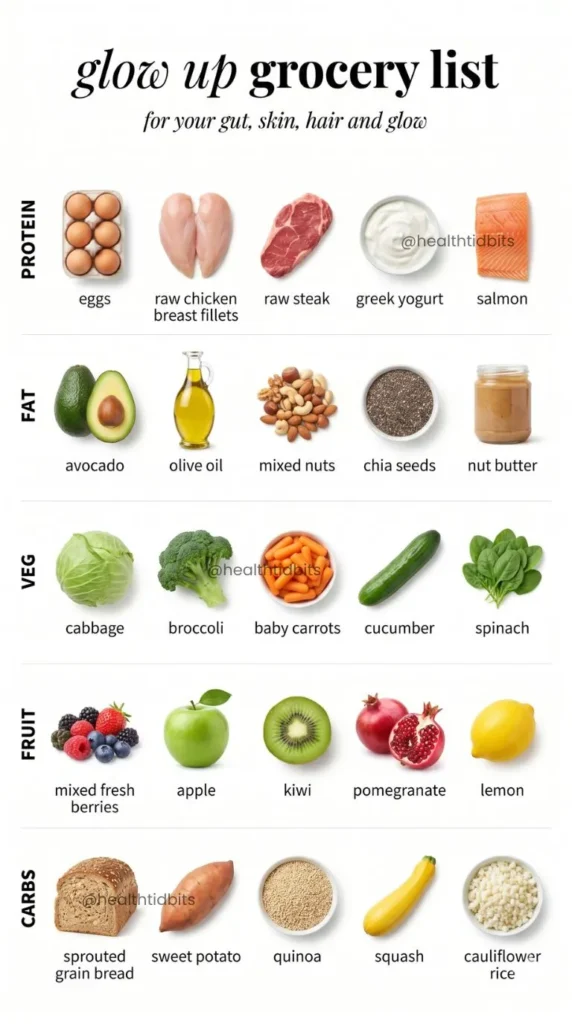
I put this list together as a real grocery guide — 25 foods that actually deliver the vitamins and nutrients your skin (and hair, and gut) need to thrive. No exotic superfoods, no expensive powders. Just real food you can buy at any decent grocery store.
Let’s get into it.
The Hero Nutrients Your Skin Is Begging For
Before we dive into the list, here are the big ones to remember. Whenever you’re choosing what to eat, ask yourself: am I getting enough of these?
Vitamin C is the one your body needs to make collagen — the protein that keeps your skin firm and bouncy. You don’t store it, so you need it daily.
Vitamin A (and beta-carotene) is the original retinol. It controls cell turnover, which is fancy talk for “how quickly your skin renews itself.” Less dullness, fewer clogged pores.
Vitamin E protects your skin barrier and works alongside vitamin C as an antioxidant team.
Omega-3 fatty acids calm inflammation. If you deal with acne, redness, or eczema, this is non-negotiable.
Zinc repairs skin and is one of the most studied nutrients for acne.
Protein gives your body the amino acids it needs to actually build collagen, keratin (hair!), and new skin cells.
Okay, now the list.
Protein: The Building Blocks
Your skin and hair are literally made of protein. Skimp here and nothing else on this list can save you.
Eggs are nature’s multivitamin. The yolk is loaded with biotin and sulfur — both essential for strong hair and elastic skin. Don’t skip the yolk.
Chicken breast is a clean source of lean protein and zinc, which your skin needs to heal breakouts and small wounds faster.
Steak sometimes gets a bad rap, but it’s one of the best sources of bioavailable iron and zinc. If your skin looks pale or dull, low iron could be why.
Greek yogurt does double duty — it’s high in protein and packed with probiotics that support your gut. And the gut-skin connection is real. A happy gut shows up on your face.
Salmon is the queen of skin foods. Omega-3s reduce inflammation, and it contains astaxanthin — the antioxidant that makes salmon pink and has been shown to improve skin elasticity and hydration.
Healthy Fats: For That Plump, Hydrated Look
If your skin looks tired and crepey, you’re probably not eating enough fat. Healthy fats keep your skin barrier strong so moisture stays in.
Avocado is rich in vitamin E and monounsaturated fats. It’s basically a glow serum you can eat.
Olive oil (extra virgin, the good stuff) gives you polyphenols and vitamin E. Drizzle it on everything.
Nuts — especially almonds for vitamin E and brazil nuts for selenium. Just a small handful a day is enough.
Chia seeds are one of the few plant sources of omega-3s, plus they’re great for digestion. Sprinkle them on yogurt or stir into water.
Nut butter is a satisfying way to get more vitamin E and healthy fats. Look for the ones with just nuts and salt — no added sugar or weird oils.
Vegetables: Your Antioxidant Army
This is where you get the vitamin C, vitamin A, and antioxidants that protect your skin from damage.
Cabbage is underrated. It’s loaded with vitamin C and sulfur compounds that support your liver — and a happy liver means clearer skin.
Broccoli brings vitamin C plus sulforaphane, a compound shown to protect skin from UV damage and oxidative stress.
Carrots are the easiest way to get beta-carotene, which your body converts into vitamin A. Eat enough and your skin literally develops a subtle warm glow.
Cucumber is mostly water (which is why your skin loves it) but it also contains silica, a mineral that supports skin elasticity.
Spinach is the closest thing to a multivitamin in vegetable form — vitamins A, C, E, and iron all in one.
Fruit: Antioxidants That Fight Aging
I picked these specifically for their skin benefits and lower sugar load.
Berries (any kind — blueberries, strawberries, raspberries) are the most antioxidant-dense fruits you can buy. The anthocyanins protect collagen from breaking down.
Green apple is lower in sugar than most fruits and contains quercetin, an antioxidant that doubles as an anti-inflammatory.
Kiwi has more vitamin C per gram than oranges. Two kiwis a day will cover you.
Pomegranate is full of punicalagins, compounds that have been studied specifically for their effects on collagen production.
Lemon isn’t just for flavor. The vitamin C supports collagen, and warm lemon water in the morning gently supports liver detox pathways.
Carbs (As a Side, Not the Main)
Here’s where I want to be honest with you. Most of us aren’t doing manual labor anymore. We’re sitting at desks, typing, scrolling. We don’t need a mountain of rice or pasta at every meal — that kind of carb load was built for people working construction or out in the fields.
That doesn’t mean carbs are bad. Your body and brain still need them. But the smart move is treating them as a side — a small portion alongside your protein and veggies — not the main event. And choosing the slower-burning, more nutrient-dense ones makes all the difference for your skin (because blood sugar spikes age your skin faster than almost anything else).
Sprouted grain bread (like Ezekiel) is my pick over regular bread. Sprouting unlocks more nutrients and lowers the glycemic impact. Sourdough is a solid runner-up.
Sweet potato is loaded with beta-carotene — your skin’s natural sun protection. Roast it, mash it, eat it cold.
Squash (kabocha, butternut, any orange-fleshed squash) is another beta-carotene powerhouse with vitamin C.
Quinoa is technically a seed, not a grain. It has all nine essential amino acids — including lysine, which is rare in plant foods and important for collagen.
Cauliflower rice is my favorite swap when I want a “rice meal” without the blood sugar rollercoaster. Bonus vitamin C.
How to Actually Use This List
Don’t try to eat all 25 foods every day. That’s overwhelming and unnecessary.
Instead, aim for variety across the week. A simple rule I follow: at every meal, build your plate with a protein, a healthy fat, and lots of color from vegetables. Add a small carb side if you’ve moved your body that day or if you’re genuinely hungry for it.
Skin changes take time. Most people see real differences in 8 to 12 weeks of eating this way consistently. Give it a season. Trust the process.
Your skin is a long-term project. The good news is, every meal is a chance to feed it well.